Two kinds of ship, two kinds of holiday
The word cruise covers two quite different products in Greenland, and the same agencies often sell both.
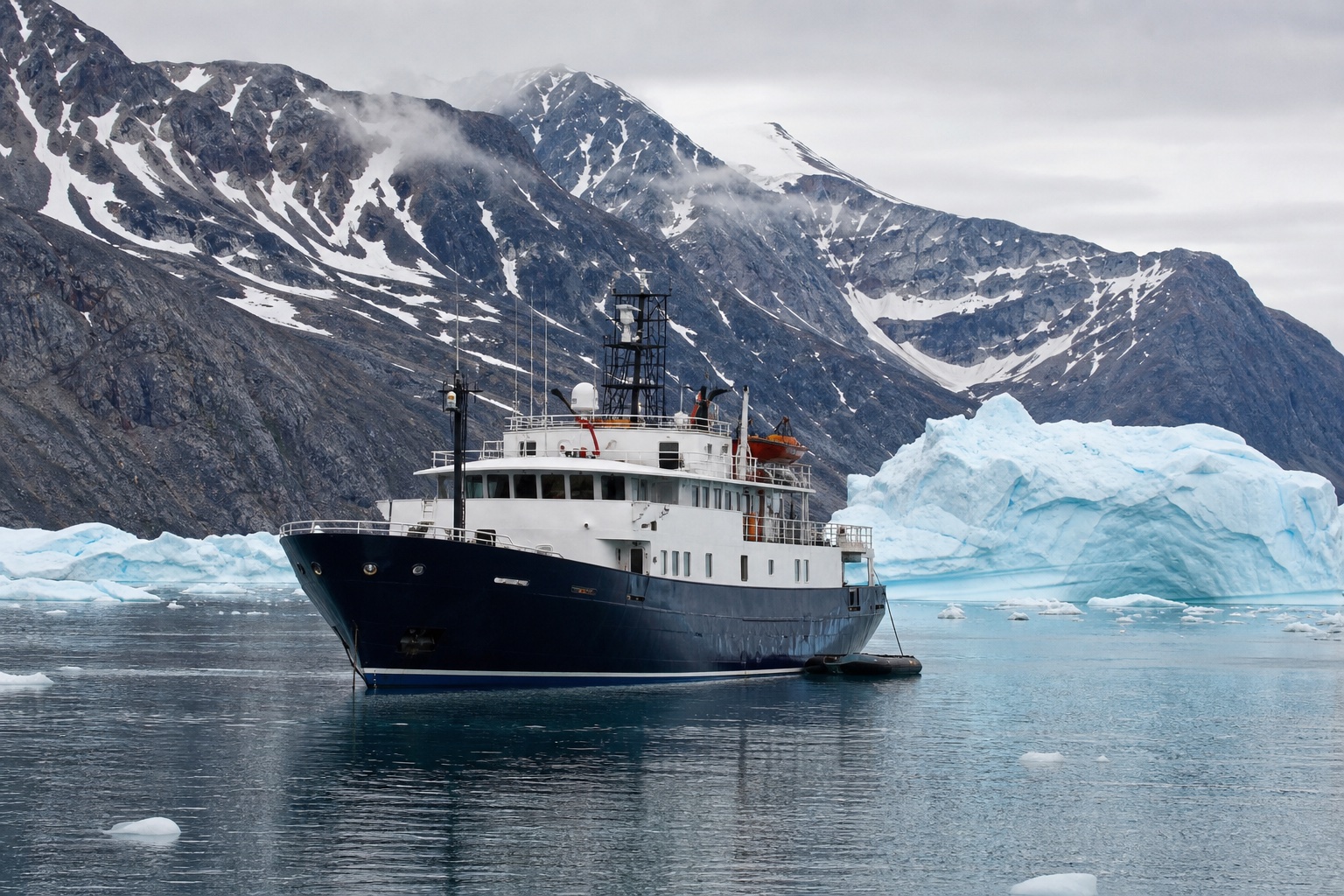
Expedition ships are small. The vessels working these waters typically carry between one and three hundred guests: Aurora Expeditions' Ocean Explorer takes 206, Silversea's Silver Endeavour 220 and Silver Wind 274. They are ice-strengthened under the classification societies' Polar Class scheme, in which PC6 and PC7 cover summer and autumn operation in thin to medium first-year ice, and most of them carry inflatable boats. Those boats decide what the ship can do, because without them you can only go ashore where there is a quay.
Large cruise ships are ordinary ocean-going vessels that have added Greenland to a route between Iceland, Canada or northern Europe. MSC, Holland America Line, Norwegian Cruise Line, Viking and Silversea all call at Greenlandic ports. They carry thousands of passengers, and they can only visit the handful of places with the depth, shelter and space to take them. There are no landings in uninhabited fjords, and there is no fleet of inflatables large enough for the passenger list.
| Expedition ship | Large cruise ship | |
|---|---|---|
| Guests aboard | roughly 100–300 | often over 2,000 |
| Ice class | usually Polar Class certified | rarely ice-classed |
| Landing without a quay | yes, by inflatable | no |
| National Park and Scoresby Sund | yes, with a permit | no |
| Calls per voyage | many, often small places | few, larger towns only |
| Weather dependence | high, route adjusted en route | lower, fixed calls |
The difference is not only comfort. When the Ocean Explorer ran aground in Alpefjord inside the Northeast Greenland National Park in September 2023, it was precisely somewhere no large ship would have been. Expedition vessels go further in, and they do it where help is a long way away.
Where the ships actually call
The figures here surprise most people. South Greenland, not Disko Bay, is the country's busiest cruise region. Visit Greenland's 2025 count distributes cruise guests as follows.
| Port | Cruise guests 2025 |
|---|---|
| Qaqortoq | 46,327 |
| Nuuk | 44,156 |
| Paamiut | 29,873 |
| Nanortalik | 23,900 |
| Sisimiut | 16,669 |
| Ilulissat | 10,931 |
| Kangerlussuaq | 7,264 |
| Ittoqqortoormiit | 5,634 |
| Tasiilaq | 2,714 |
Nuuk is the only place with genuine alongside berths. The port company Sikuki operates the 100-metre Atlantic quay with ten metres of water, set aside for cruise ships from June to September, and a smaller feeder quay for little expedition vessels. It is worth being plain that Nuuk has no dedicated cruise terminal: the large terminal built in 2017 is a container terminal. An expansion of 350 metres of quay was announced in October 2025, of which 150 metres will give priority access to the Joint Arctic Command.
Everywhere else the ship anchors off and guests come ashore by tender or inflatable. That includes Ilulissat, which has no cruise quay. This has practical consequences: if the wind gets up, the landing is cancelled and the ship sails on with nobody having set foot on land.
West coast, east coast and the National Park
The west coast is the accessible side. Sailing runs, on the operators' own published seasons, from June to September with the weight of it in July and August, and the routes follow Disko Bay, Sisimiut and the fjords of South Greenland. This is where the large ships go.
The east coast is another world. Scoresby Sund is the largest fjord system on earth, and the settlement of Ittoqqortoormiit at its mouth is among the most isolated inhabited places in the Arctic. Sea ice decides when a ship can get in, so operators generally sail there only in August and September. We would not put a fixed date on it; the season depends on the year.
The Northeast Greenland National Park is the largest national park in the world at 972,000 square kilometres, established on 22 May 1974 and expanded in 1988. It has no permanent population. You cannot simply sail in: cruises within the park require a permit from the Expedition Office under the Government of Greenland's ministry for nature and environment, the application fee is 4,000 DKK, and the first parts of the application are due twelve weeks ahead. At cultural heritage sites the Greenland National Museum requires its own authorisation, and many of those sites may only be visited with an approved guide and no more than twenty people at a time.
Ships in Greenlandic waters must also report into the GREENPOS system run by the Joint Arctic Command. That is not a formality: it is the position report a search would start from.
How a cruise differs from a land-based trip
The most important difference is that the ship is both the hotel and the transport. There is no road network between Greenland's towns, so a land-based circuit needs a domestic flight or a boat for every move. Aboard a ship that problem does not exist. It is the real reason a cruise can visit eight places in ten days while a land trip of the same length manages two.
In exchange, you do not decide. The route is set in advance, changes are the captain's to make according to weather and ice, and you are ashore for hours rather than days. You do not choose Ilulissat for a week; you get a morning there. For some travellers that is exactly right, because you see a coastline you would otherwise never reach. For others it is not enough.
Financially it is a different structure too. Meals, cabin and usually most excursions sit inside a single price, and no domestic air tickets are added on top. We have gathered the prices we could find published in our guide to what a trip costs; here it is enough to say that a cruise fare cannot be set against a land-based quote until flights, accommodation and meals have been taken out of both.
Finally, some activities do not exist in the cruise season at all. Dog sledding is legally confined to West Greenland north of the Arctic Circle plus East Greenland, and the season runs from January to April, which is outside every summer sailing. The same is true of the northern lights, visible from September to April. Humpback whales, on the other hand, are in Disko Bay from mid-June to August, which is squarely inside the sailing season.
A day ashore
A call usually begins early in the morning and ends in the late afternoon. If the ship is at anchor, getting people ashore takes time, and that time comes out of the day.
Ashore, the programme is typically a town walk, a boat trip, a hike on the fell or a visit to a local family. The towns are small enough that you can also walk around on your own; Qaqortoq, Sisimiut and Nanortalik are all manageable in a morning. The distance between the harbour and whatever you came to see is rarely the problem. Time is.
There are rules that guests notice. The operators' association AECO binds its members to guidelines that include a minimum distance of 500 metres from polar bears and 300 metres from walrus at sea, 50 metres ashore. There are also community-specific guidelines for individual settlements, among them Nuuk, Paamiut, Tasiilaq and Ittoqqortoormiit. They exist because calling at a settlement of fifty people is not the same as calling at a capital.
Capacity and the overtourism argument
The question of whether Greenland is taking too many ship-borne visitors is a real one, but it is rarely about what foreign headlines assume.
Look at the ratio of residents to guests. On 1 January 2026 Nuuk had 20,298 inhabitants, Ilulissat 5,150 and Qaqortoq 3,081. Qaqortoq received 46,327 cruise guests in 2025 — roughly fifteen times its population in a single season. Ilulissat received 10,931. Measured in ship-borne visitors, Ilulissat is a modest cruise port, however often the town is used as the picture of Arctic overtourism.
It is also worth knowing the difference between two numbers that both get called cruise guests. Visit Greenland counts unique people: 93,897 in 2025, down 1.3 per cent on the year. Statistics Greenland counts shore landings, meaning once per town a passenger visits: 213,674 in 2025 across 232 calls. Both are correct, and they do not describe the same thing.
There is an asymmetry in the data worth knowing too. Cruise guests are counted; air-borne tourists are estimated. Visit Greenland itself notes that the number of international tourists cannot be reliably derived from air passenger figures, because residents and tourists cannot be separated with sufficient confidence. So when we say roughly half of visitors come by ship, one half is measured and the other is calculated.
The Greenlandic objections are specific. In July 2026 the municipality of Sermersooq asked cruise ships to keep their distance from hunters and fishers working in Nuup Kangerlua and not to disturb wildlife with the reindeer hunt approaching. In the settlements the dividing line is ship size: a sheep farmer in Kapisillit has said plainly that he does not want the very largest ships calling at his settlement, while a resident of Qassiarsuk is positive about ships carrying a couple of hundred guests, because then the encounter can actually happen. Ilimanaq has around fifty inhabitants.
In Ilulissat the dispute is mostly about who earns from the visitors. When a single ship did not call in 2025, the loss to the town's businesses was debated politically. That is a distribution conflict rather than a capacity conflict, and it is worth keeping separate from the question of how many ships the coast can carry.
The 2025 tourism law and what it means for ships
Greenland got its first proper tourism law with Inatsisartut Act no. 62 of 25 November 2024 on tourism activities and on zoning for commercial activities. It entered into force on 1 January 2025.
The Act requires a licence to carry out tourism activities. Businesses with under 50,000 DKK of annual tourism revenue are exempt. A natural person can only hold a licence with a registered address in Greenland and full tax liability there, and a company must be resident in Greenland with at least two thirds of both its capital and its voting rights held by people meeting the same test. On top of that come a written safety plan with a risk assessment and emergency response, available to guests in Greenlandic and English, and professional liability insurance.
For ships the distinction is precise. Carrying passengers to, from or within Greenland falls outside the Act where no tourism activity is carried out in connection with it. But landings, inflatable-boat excursions and guided walks ashore are tourism activities, and they therefore require either a licence or purchase from a licensed Greenlandic company. The Act also empowers the government to restrict commercial activity to particular areas, periods or conditions, and that power reaches over the transport exemption.
There is a transitional period: for activity lawfully carried on immediately before entry into force, the Act only applies from 1 January 2027. That is the deadline the industry is working towards, and it is why foreign expedition operators have raised objections to the ownership rule — in uninhabited areas there may be no licensed local company from which to buy the landing.
Two things are not in the tourism law and should not be attributed to it. It contains no cruise passenger tax, and it contains no requirement of community consent for landings.
The tax is separate legislation. Under Executive Order no. 81 of 21 December 2023 on port and cruise passenger duty, a cruise passenger duty of 50 DKK per passenger has been payable since 1 January 2024 for each port call or arrival at an anchorage in one of the designated ports. Municipalities may additionally levy an environmental and maintenance fee of up to 50 DKK per passenger per location, payable whether or not the passenger goes ashore. Port dues for cruise ships over 30,000 gross tonnes were doubled at the same time from 1.10 to 2.20 DKK per gross tonne. The rules were amended by Inatsisartut Act no. 79 of 21 November 2025 with effect from 1 January 2026; the passenger duty is still 50 DKK.
Is a cruise the right choice
We would not recommend one form of travel over the other, but we would put the choice sharply.
A cruise gives you coastline. You see fjords, settlements and icebergs no land route reaches, and you avoid building a trip out of individual domestic flights that can be cancelled. The price is that you never get more than a few hours anywhere, that the route can change without your involvement, and that anything needing snow or darkness falls outside the season.
A land-based trip gives you depth in one place. You can stay put when the weather is bad, go out again the next day, and spend a whole day on the thing you came for. The price is more transport legs, more bookings, and a greater risk that one cancelled flight topples the programme.
If we had to give a single piece of advice, it would be to choose the size of ship before the route. A small expedition vessel and a large cruise ship in the same week on the same coast are not two versions of the same trip. They reach different places, they go ashore on different terms, and they meet Greenland differently.
Last reviewed August 3, 2026